Things I learned from you

That nature is comprised of fractals, a golden ratio seen in a sunflower’s face and a fern unfurling, that a wave’s crest can be reduced to the rise and fall of sine and cosine, of trigonometry in motion,

That nature smiles when you plant kamote leaves, that she blesses you with rain and sweet potato tubers, that there are spirits in the trees and that the ground upon which we tread is alive

That some earth needs to be softened in order for plants to grow and indeed you sprouted forests from clay and hoof torn dirt and I learned that some people are better teachers than parents,

And I learned that the same person who can birth foliage from barren earth, command an oasis with toil and care, delighting in palms that reach to the sky

May not delight in their own offspring’s unfolding, that they will plant them in darkness, abandon them in barren land and blame them

For their leafless stems and flowerless bloom

I learned that you should have been a botanist and not a mother.
skinless

and like all the other skinless 
you slide through your days unnoticed 
remember that army obstacle course you entered with old school friends, 
when you ran through mud and manure and contracted flesh-eating proteins
that removed your epidermis
how easy it was for the skin to peel, for viscous fluid, 
clear, bloodless, to roll down your calves
and how easy it was for the cardigan to rip the interconnected cells
from your flesh

you have no skin and yes, there are strengths how easy it is
to feel the young jonquils unfurling from your flesh
with a glance and you are stamen and stem
how easy it is to exude sweet spring musk
horny jasmine and magnolia on heat
and to sit beneath the soft skinned melaleucas
and imagine coccyx reverting to tail, bones emptying and 
hair reverting to feathers
how easy it is to flit amongst the mangroves

also, how difficult it is to the be the skinless amongst your predatory race,
you cry beneath those paper-skinned trees, 
and you think of a friend’s client or a client’s client, 
the one who swallowed razor blades
and apparently the oesophagus is resilient
and you hate that word resilient,
a word used as both blindfold and gag
to ignore scar tissue and shrapnel in the belly
to avoid asking could life 
be lived another way.


a week of seeking solace

I feel broken, I have not felt broken like this before,

and the wise woman that reads your whispers,

 the one who breaks into Italian when she is delighted or drops her guard,

 she says maybe, maybe you are simply aware of these long-broken parts

and you speak these beautiful, awful truths to a forever friend

whose fingers are always moving and she says

think of pottery though

when the ceramic is being glazed, it looks like it is breaking,  

but no, it isn’t breaking,

and you’re not breaking, she says,

your surface is splintering but your interior is still intact

as she drives you to the ocean to comb moss

that grows like human hair on sea rocks

and there’s your friend with the renaissance soul

the latest one to make a new life and weary and sleep stolen

she introduces you as a writer first,

 not a teacher/therapist/ academic,

not a failed woman nor a would-be wife

and she says we must create because

nothing is secure and

life is uncertain

and life is short-

and this same week you are running to the river, and you are never too

quick that you cannot stop for the burst of cherry blossoms ushering spring

and this is a delight,

a kindness,

that you can stay still enough to capture the bees

dancing across blossom and bud

and across the road

you hear the man you cannot stop loving for his improbable love of unlikely song

and he’s playing the uillean pipes across the field

and you are breaking

still and the river

will take you, broken or cracking you are mostly organic, and your banyan tree will hold you amongst her buttress roots and will remind you that

all that lives

is prone to break.

Even still

it’s not safe to drink water from the sky anymore,

and the soil is laminated in plastic.

even still, the egrets have returned to Cooks River

and across the Tasman the Waitangi has human rights

the plagues won’t stop because the tundra is melting,

because the not-us creatures are homeless and searching.

even still, the winter wattle is in bloom, and all along the estuaries, yellow scrub grins.

and we are a treadmill species moving not moving

even still you see lorikeets glide across campus, nesting in the cabbage tree palms

and when they ask you where do you see yourself in five years ten years

how far on the treadmill would you like to have run, there is the only the treadmill

‘even still,’ you say, ‘I will step into the empty space beside the machine

where do I see myself?

Beside a reborn river,

playing Celtic reels

and speaking soft sounds

on sacred

ground.’

day

well inshallah, the shop keeper says, when you shape your face in sympathy and say maybe the day will improve, she has a cervicogenic headache from a stiff neck and she’s alone with the spices today, no one will help, and the headache is bad, terrible-

and you’re only buying frozen okra today, because breathing is expensive, but your mother raised you to survive so you scour the ethnic supermarkets, Lebanese, Greek, Vietnamese, and when you return home, you harvest the green chilli from the plants that have turned to twigs and you pluck the calamanci from your tree and you call it calamanci because cumquat is an ugly sound in your mouth-

two days ago the doctor, he told you no, your heart isn’t dying quite the opposite, and you said what about the chest pain, what about the fist wrapped around my heart with all its grip strength, squeezing and he said well if you can run to the river like you do, then your heart is fine and your blood pressure is superb and your lung capacity is outstanding-

your heart is not dying.

inshallah, god willing.

this is what you know how to do. run. you run to the river, and you keep running so your chest breathes freely and the cormorants swoop to the river’s surface and there are butcher birds in the casuarina scrub, and you keep running-

inshallah, god willing –

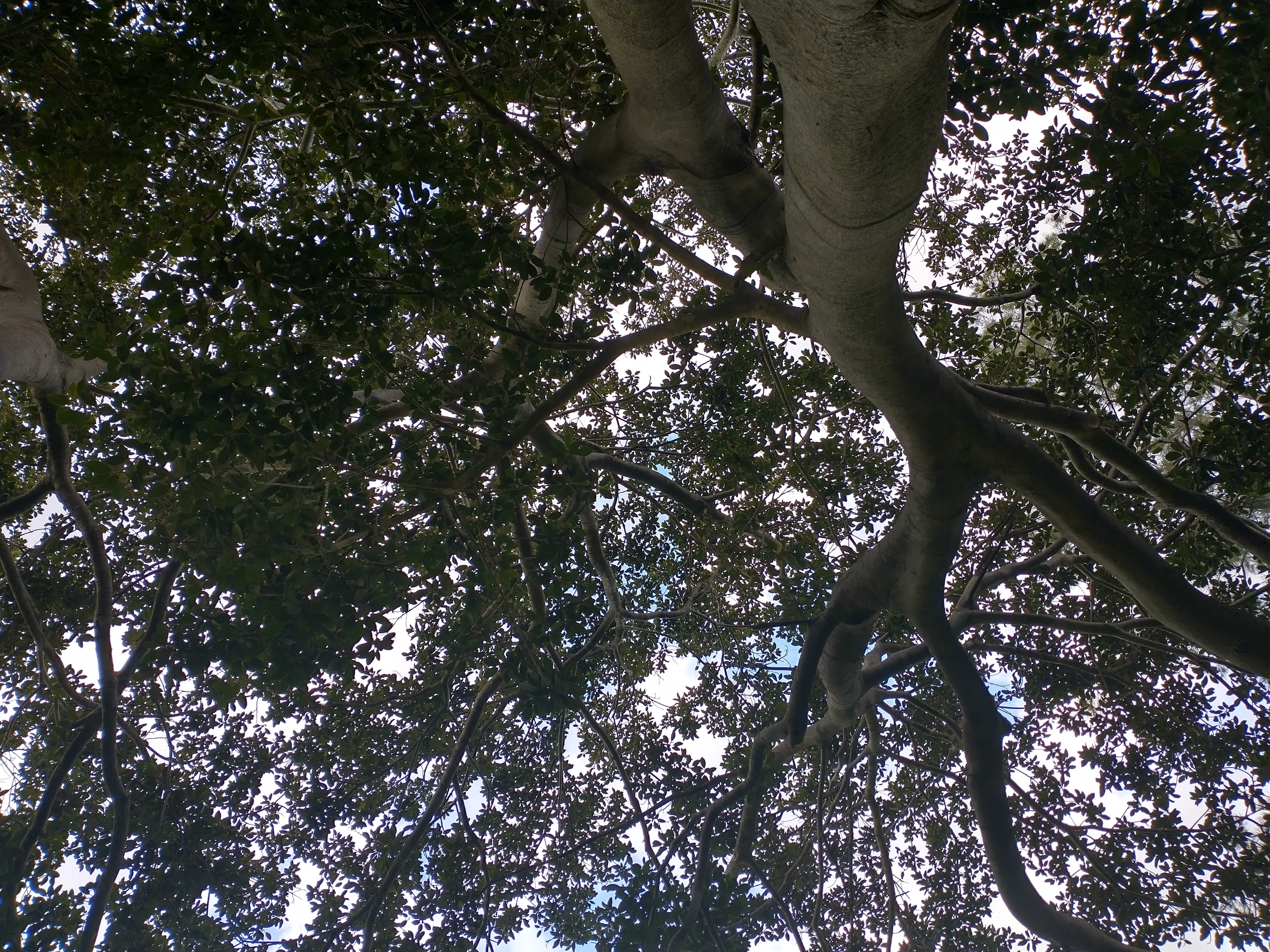
the august winds usher the chill but there is always enough sunlight in Sydney even though it’s our turn to flood while other nations burn and you run to your tree that breathes upon the riverbank, the Moreton Bay Fig, whose branches swoop upwards and down and whose buttress roots shelter all the ground dwellers, invertebrate, vertebrate, human.

you run to her because you have many jobs in this octopus world of juggling, of hustling to death, but this is one job that doesn’t exhaust you, custodian, cleaner, protector-

you protect her from your world, as best you can, protect her from the world that makes fists out of hearts, and you pull plastic bags and plastic bottles and glass bottles from her body and inshallah your tree must breathe, she must not suffer under human refuse, she must never know suffering as you do-

The options after return ( non-fiction in progress)

Suicide is always an option for me. It is certainly not the most favourable. But I am a woman who likes to anticipate all possibilities, I must note the points of ingress and egress. Yes, I need an escape route. I am cursing myself for returning here, to this place of jagged, curved beauty, to this place of fear. Only a person inflicted by Thanatos, the death instinct, enters a poem into a competition in her hometown. A town she has avoided for 12 years, because of her mother and all that her mother entails. What am I, but someone who flirts with liminality? The hometown writer’s centre publishes my poem; I agree to read at the launch. Rather than using my pen name, they publish my actual name on their website. I don’t blame them; the Arts is not funded in this country. They are understaffed by overworked volunteers. A quick google search and you could trace me.

Thinking of you makes me suicidal.

Feeling hunted, I return to the place that birthed me in fear. It is a narrow place, nature dictating where intruders can settle, a strip of land between escarpment, between mountains and the Pacific Ocean. I have learned from the fearful place that there is always an escape. The sea will always take me, and the headlands will oblige, if I ask. A few loose rocks and the cliff will release its cargo.

This strip of land is beautiful, in the same way that the violin is beautiful, with its curvatures and jagged edges, depth and tone. If I stand in the correct space, I’ll find the natural harmonics, the precise piece of earth that vibrates. And here is the hope. If you find me, let the earth take me instead. This is my plan. I will walk past the Norfolk Pines, those pencil point ones denuded of needles, those ones that house generations of cockatoos, trained in the art of fried food thievery by the incorrigible seagulls. I will press wet sand between my toes and watch the patches of sea twist brown and green and blue. The water will have me before I ever return to you.

What is wrong with me that I am terrified of you? We share DNA. You birthed me. How can I fear a person who is half of myself?

If you stay too long in the sea (poem in progress)

If you stay too long in the sea
The mermaids will take you, her cousin said,
a bored babysitter, fourteen.
Reluctantly, she exited, four and in love
with wave texture, 
sand texture
in love with all that
reliably rose and fell -
If you walk on the cliff rocks alone
The men will take you, her mother said. 
Instead, she brought a kitchen knife
and clambered along capricious cliffs
Seventeen, in love with all that was
Predictably harsh, in love with a
A cadence of crest and crash.
If you bring a towel, 
We’ll be more comfortable, the boy said.
Twenty-one and agreeable, 
She lay in the private cove 
Hidden but exposed.
Twenty-one and watching beyond him
Wanting the salt on her skin
Her body submerged
As the shallows caressed her. 
If she leaves now, she thinks,
She will arrive before the families 
Thirty nine and sensible she arrives at dawn
Seeking solace, she wades into the rock pools
A hermit crab peers from its jagged crevice,
Watching, not judging
as she floats on her back
as the rising sky blinds her
and the ocean holds her.

On writing and nature

Let me tell you something about trees. They speak to each other. Just think what they must say? What could a tree say to another tree? I bet they could talk forever. The things they must see, that must happen around them, the things they must hear. They speak to each other through tunnels that extend from their roots, opened in the earth by fungus, sending their messages cell by cell, with a patience that could only be possessed by a living thing that cannot move. It would be like me telling you a story by saying one word each day.

from a low and quiet sea by Donal Ryan (2018)

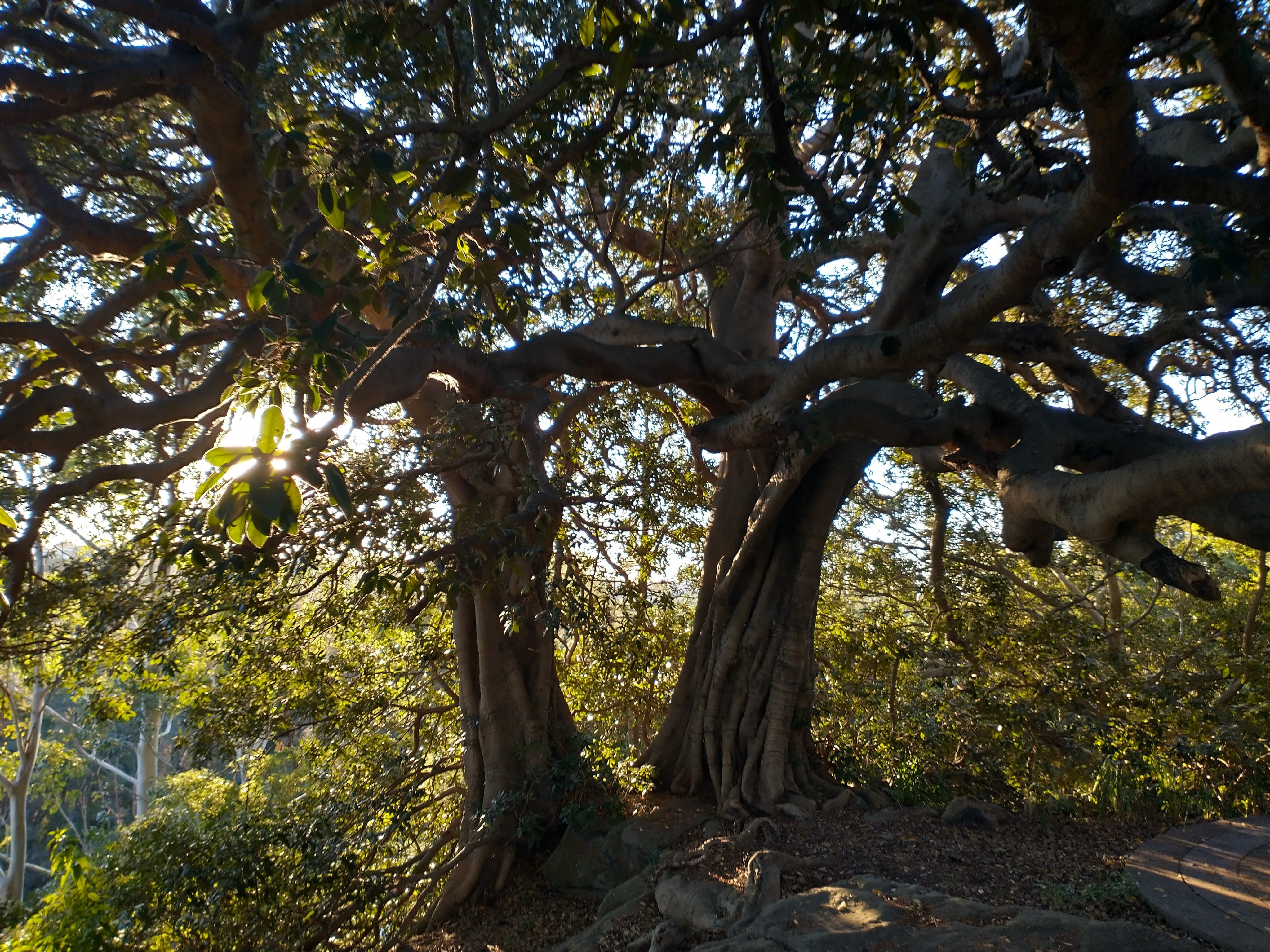
My photosynthetic friend, the Moreton Bay Fig

Humans are absurd. Frequently, I need a break from my own kind, lest I descend into an unacceptable level of absurdity. You know the kind. Underwear on head, sock puppets at work, or the kind of inflated self importance that leads to podcasting without a journalism background.

A few times a week I run to the river where I talk to my photosynthetic friend, the Moreton Bay Fig (pictured above). She allows me to sit between her buttress roots, which radiate out towards Cooks River, and in the other direction towards the reserve where she shares her resources with conifers, other fig trees and paperbarks. Neither of us waste time making sound. Instead we enjoy a shared silence that only veteran friendships understand.

It is only through The Silence that the words emerge, where characters coalesce and narrative becomes form. Like others afflicted with biophilia, I draw this silence from nature. Writing is not for the impatient, which is difficult when you live in a world where worth is assigned to productivity. It can take years to write a good book, which is why it irks me when I hear people criticise George R.R. Martin for his delay in writing the last novel in The Game of Thrones series.

To be patient with the process means to have faith in the future. It means that you must have faith in yourself, which is often a herculean feat (and a topic for another blog post). It means that people may shun you as you experiment with plot, as you follow characters who meander past you and travel to the underworld. It means that non writers don’t understand that it can take years to produce something solid, that it takes time for a story to grow and its roots to be sturdy. And it means a level of private despair, because you know that it is a process that cannot be rushed in a world where productivity is worshipped.

But my photosynthetic friend reminds of the rhythms of nature. She also reminds me that not only are humans absurd, we are the only species that willfully persists in destroying itself. Over production of the cells in the body is known as cancer. Over production in aid of over-consumption is clogging our oceans with plastic and overseas landfills that leach toxins from electronic waste into the ground water.

To worship at the altar of productivity for its own sake is not just destructive to our own species. We are at the brink of bringing entire eco-systems down with us.

So join me in raising a glass of chlorophyll (I know essentially it’s plant blood so the metaphor is a tad macabre). But raise your glasses nonetheless, dear writers. Here’s to the rhythms of nature and to the process of silence. Here’s to balance, contemplation and a different way of living.

If you feel the nature vibes check out the following links: