What they don’t tell you

Prose poetry in three movements

What they don’t tell you (movement one)

…is that you’ll be clutching at the edges of life, ripping nails clean from your nail bed, leaving bloodied fingertips too wet to grasp ledges. What they don’t tell you is that it’s a loss, nobody tells you that you’ll rake the fur lined, dust coated carpets for powdered residue, that you’ll sneak into friends’ bedrooms just to hold their prescription Endone in your hands, just because…

because there is hope in the holding.

What they don’t tell you is that instead of poppy seeds, you’ll be downing opened bottles of Jacob’s Creek Chardonnay, three months opened and more vinegar than wine, that you’ll be eating when your body is not hungry, grease drenched burgers and cardboard fries, but that there is more than one type of hunger. And you’ll run by the river, through muddy, waterlogged grass, around and around soccer fields until your knees lock in protest and the lactic acid paralyses your calves.

That when you can no longer run, you will crawl home and lie on your rug weeping, that the weeping will collect in a pool around your foetal form. What they don’t tell you is that sobriety is grief-stricken, a period of mourning.

That gear was a life partner that held you,

and that person is no longer there.

What they don’t tell you (movement two)

….is that your skin will curl and break, that wounds will weep, and an infection will break, that the compulsion to create will seep from your body. Boils will open and pus will leak, and you will write in a way that you have never written,

in between students and clients, on office note pads, with scratchy ballpoint pens, on pizza take away menus and envelopes screaming overdue bills,

you’ll write

in a grasping, clutching way, and you’ll be driven to sound, to rhythm, to the edges of life, that your ears will sharpen to your violin, attune to the hidden notes on that fretless instrument you play. That your ears will recognise that B is shrill, stern like an old school ma’am, that D is resonant but calm, a yogi and

these are moments you don’t crave opiates,

moments of softness or heart, your cat’s paws on your chest for instance, a friend who buys you Thai chilli basil tofu and steamed rice for lunch, and laughter,

yes laughter, untethered.

What they don’t tell you (movement three)

They use the word clean, but that’s a misnomer, as though passing a drug test means your body is free of the impurities and that’s not true,

the body remembers.

cells remember.

And how can they not remember flesh breaking and heart calcifying and a child running to the corners of breathing so nobody can break her further

Flesh and bone hold your own trauma and the cells your parents’ and grandparents’ trauma. And what do you do with this epigenetic fate?

You pick up your violin and play the saddest of scales, D minor, the musical key for dirges and laments until your neighbour bangs on your ceiling and you stop, but the knowledge is there. You’re working out how to live with the library of knowledge trapped in subcutaneous fat, you’re working out how to hold yourself when gear was the only love who knew how to hold you.

skinless

and like all the other skinless 
you slide through your days unnoticed 
remember that army obstacle course you entered with old school friends, 
when you ran through mud and manure and contracted flesh-eating proteins
that removed your epidermis
how easy it was for the skin to peel, for viscous fluid, 
clear, bloodless, to roll down your calves
and how easy it was for the cardigan to rip the interconnected cells
from your flesh

you have no skin and yes, there are strengths how easy it is
to feel the young jonquils unfurling from your flesh
with a glance and you are stamen and stem
how easy it is to exude sweet spring musk
horny jasmine and magnolia on heat
and to sit beneath the soft skinned melaleucas
and imagine coccyx reverting to tail, bones emptying and 
hair reverting to feathers
how easy it is to flit amongst the mangroves

also, how difficult it is to the be the skinless amongst your predatory race,
you cry beneath those paper-skinned trees, 
and you think of a friend’s client or a client’s client, 
the one who swallowed razor blades
and apparently the oesophagus is resilient
and you hate that word resilient,
a word used as both blindfold and gag
to ignore scar tissue and shrapnel in the belly
to avoid asking could life 
be lived another way.


ways of holding space

Mark the calendar:

the 29th of August, the day you failed her. After years of trying, imagining yourself a one-woman Marvel multiverse, you have turned out the lights,

and curled as adult foetus, beneath your fur lined, patch work quilt, one hand on your Calico cat who has curled beside you. Another hand on that blood pump other people call a heart.

You will not spend 12 hours in A & E in the bustling inner-city rooms where it is not uncommon to see a half clothed, stale breathed man handcuffed to the bedframe, a uniformed officer at his bed, and neither will you spend 6 hours in the smaller suburban A & E, where traces of blood have not been cleaned beneath hard plastic chairs-

You can no longer hold space for her, though this is your job. Holding space. Leaning in and listening to the themes that reverberate in the pauses and the sentence periods.

Because the way you listen can speak tomes,

listening as echolocation,

as homing device,

I am here, I am here

you are there and I travel beside you,

but tonight, you scream to be the heard, the listen-ee, not the listener,  

instead, you rest your ear against the Calico, letting her breathe softness against your chin, and she shares her purr with you, the vibration that travels through her when she is in her vet carrier, or when the neighbour’s Chihuahua ventures not too close but close enough,

she shares her purr, that self-soothing soft rumble from deep within her larynx,

come, the Calico says,

there are other ways of holding space.

a week of seeking kindness

will AI one day make men redundant, he asks, not humans, I mean just men because women will always be useful, and do you know how existence travels in cycles, and men have been on top for millennia, well it is probably women’s time now-

and you can’t get rid of him, the college student who arrives in your class before you, and leaves after all the students are gone, despite the torrential rain and the assignment deadlines, he likes to follow these threads of thoughts, likes to ask your opinion-

the day before you are sinking your own fingertips into miniature tubs of sticky acrylic paint. Your client is drawn to the IKEA bottles that squirt paint like tomato sauce and he is delighted with the swirls of gold and silver and fluorescent orange on the A4 paper. Earlier another little girl is painting a sunrise with glow in the dark rave colours, and there is colour everywhere. On everyone’s hands, on the table, on school uniform, hijab, wall, floor mat

and these are children whose minds slip-slide from surface to surface. Never settling. Yet here with this beautiful, fractal rainbow mess they are calm, and it makes you wonder whether therapists should simply be replaced by artists and acrylics, watercolours, oils, pastels available at every medical and allied health service-

before the colour smear, you sit three hours with a grandmother, a guardian of a teen whose mind doesn’t conform and therefore no one else will have him, but the grandmother talks and you lean into her talk, which is both direct and circuitous, and anyway

you have been trained to hold space,

and she says, no he cannot tell the time or understand his multiplication tables, but he can play the piano by ear just by listening to a song once. You tell her that perfect pitch is rare, a unicorn skill,

and she says,

yes,

my grandson has a gift.

**

Later, you remember what your mother once said, that nature seeks an equilibrium, where one talent or gift is outweighed by a deficit-

earlier that day you had called your own therapist because there was that familiar hatred, the urge to slam your skull against a jagged stone surface and over and you would do it, damage the parietal and temporal lobes to have a moment’s respite-

because you were never enough for people who charged inflation prices for their metered love.

Then you think maybe this is nature’s balance, that your patience, that your ability to hold space and colour and meandering thought, your patience with paper cup water turned muddy with children’s paints, your ability to delight in strength over deficit-

Is nature’s counterbalance.

Or, or as you want to tell the other therapists, the teachers, the condescending colleagues who say you are too kind, as though kindness is an intellectual deficit-

Maybe this is nature’s law, and there was no gentleness, no kindness in a home that forced psychic and bodily submission, that now, as an adult, you would sell your right eye and left lung and excess haemoglobin to live in a kinder world.

Mind-field.

So, now. The search teams aren’t coming-

the fog’s devoured the deep ravines,

swallowed boundaries of ground and non-ground

elevation and air.

So, no one is coming, no one is safe

on this trickster terrain.

And now. The cavalry was never really deployed.

Though they’ve set a gift of artillery and gunpowder

at the border and

it’s all for you,

all the prayers and murals and hashtags

and kindness and never again’s

all for you, the one-person army.

Because now. The enemy doesn’t just look like you,

the enemy is you, all the many yous future present past tense-

Know this now. No one is coming. Not now but

maybe later to pick the bones clean,

to conduct a moral audit

to assess mistakes made and

codify/ ratify /enshrine the never-agains.

To logic

the illogical.

So, now, there is no police back-up inside your skull battleground,

No heroic dog to sniff tripwire in your mind-field

because the enemy is you

earth squashed between bone and air that pulses

across the neuronal superhighway,

where thoughts ignite and reignite.

And because strangely, everything is beautiful

during ceasefire/truce/evening’s pause.

And there is stillness as you sink exhausted

into gyrus and sulcus, enfolded into mind earth

gazing into mind sky,

where electricity is energy,

dancing across this silent space.

Artistic inspiration during lockdown?

“The cause of plagues is sin, and the cause of sin is plays.”

A preacher in Elizabeth England, possibly in response to Shakespeare’s plays.

Bloody brilliant, I say. The highest praise you can give a writer is to tell them that their writing caused the latest plague. Don’t tell the conspiracy theorists though…that is a whole other labyrinth of madness.

One of my friends texted me last week and asked me if she had properly signed up to this blog. She wasn’t getting any blog notifications, she said. I had to inform her that it was because I wasn’t writing content that was in a shareable state. And it is true that there is always a writer’s draft and then there is a reader’s draft.

But I haven’t been writing publicly because the content of my journals would read like a Live Journal circa 2003 and I really don’t want to drag others down into my personal mire of malaise. Despair is probably a more accurate word.

One of the myths around creative practice is that creative types ‘need’ depression to activate the creative juices. I call B.S. There is a relationship between the extremes of emotion and creativity, but I think the causation is reversed. Creative life helps us with despair, and not the other way around.

Another friend told me that her daughter, also a writer, is struggling with inspiration at the moment. Inspiration often comes from observing life around you, by sitting in a coffee shop and listening, for example. Inspiration comes from immersing yourself in the ebb and flow of life. At the moment, life is certainly not flowing for us in Australia.

Lockdown is a unique crisis in that we are forced to experience it in isolation. One of my Melbourne friends, when I asked her how she has coped with a prolonged lockdown, said “Look, I tell myself that all the government wants me to do is stay at home. I can do that. It’s not like they want me to fight a war in Europe or anything.” I also have friends who’ve lost generations of family members in South America. Compared to such loss, staying at home seems like a simple ask.

But as human mammals, primed for interaction, lockdown has severe implications for those of us living on our own. The chattering mind is a dangerous place to be lost in. And for a writer, stream of conscious writing died with the Modernists. So what is the answer when we are starved of inspiration?

Seek comfort rather than inspiration, is my answer. If it means reading fantasy or improbable crime fiction, than so be it. If it means taking photos of flowers on your android with an Instagram filter and calling it ‘high art’, then so be it.

And maybe there’s a case for accepting bleakness and writing through the bleak. Apparently, Shakespeare wrote King Lear during the bubonic plague, and if I’m honest, who doesn’t love a tragedy with a bit of eye gouging? 300 years prior Boccaccio wrote The Decameron during the black plague in Italy. In full disclosure, I am still on page 3 of the book, but I’ve been told that out of bleak can come the bawdy and the tragi-comic.

Because really, if you follow the bleakness through to its logical conclusion, we encounter a bit of lightness, a glimmer of hope and a large slathering of absurdity.

Covid kilos, cake and kindness

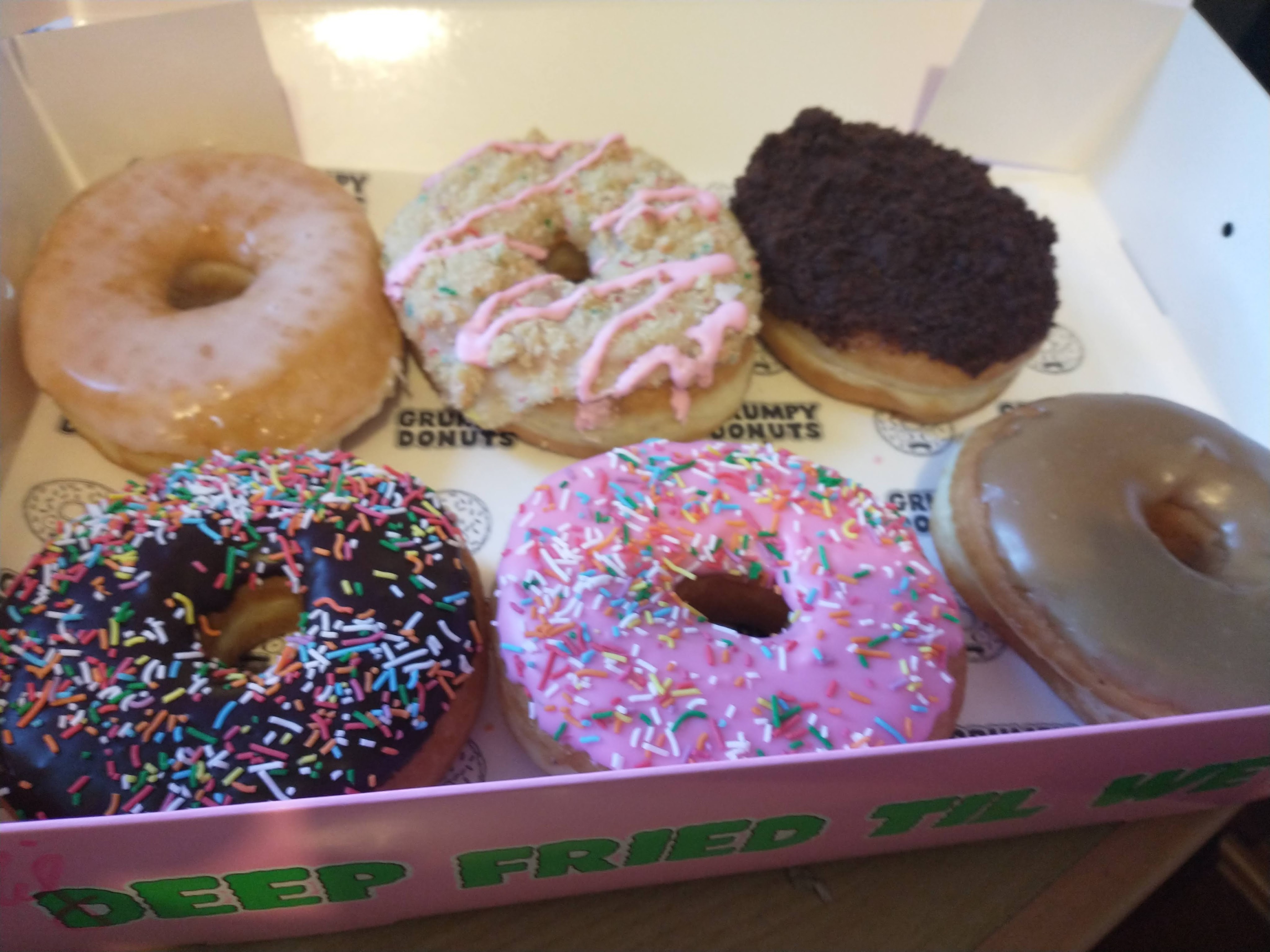
A shout out to Sarah, in Melbourne who ordered me Grumpy Donuts for my birthday

I love cake.

When I eat vegan Italian yoghurt cake, it feels like I’m making love to a cloud. Pink yeast donuts taste like happiness and there’s a plant-based chocolate mud cake from South-West Sydney that tastes like holiness. I haven’t met a cake that I didn’t like. Except for “cakes” made by misanthropic bakers who replace sugar with Splenda and vegetable oil/butter with coconut oil. Those “cakes” taste like sadness and don’t count as real cakes.

Apparently the covid kilos are inevitable. I know lots of people are bored or suffering plague malaise. They attribute their covid kilos to boredom. Personally, I’m not bored. I’ve found a myriad of things to do in lockdown. Learning an obnoxiously high-pitched instrument is a lot of fun. But I still court those covid kilos.

It does make me thing about the role of food in our lives in times of uncertainty, crisis, and loneliness. In almost every culture, food is not just nourishment. Food is used in celebration, as a reward and sometimes as a sign of love. In many Asian cultures, the first thing you say when you greet a friend or family member is ‘Have you eaten?’ I’m certain there are comparable phrases in other cultures.

Now our friend Freud might say my love of cake is symptomatic of an oral fixation, unmet needs in infancy etc etc etc, but that’s a rabbit hole for which I don’t have time.  Instead, I’d like to take my analysis out of the psycho-analytic gutter and examine food craving in the context of human needs. Maybe our desire for comfort food is symptomatic of a desire for deeper connection. We desire the sensation of connection with others and ourselves. We desire comfort. We desire kindness.

But we’re taught to be islands of self-sufficiency. The Western lone hero does not ask for comfort or kindness. We are taught that kindness interferes with achieving our goals of success and proving that we are better than others. We’re taught that the only connection that is worthy is the one that takes place in the bedroom with an intimate partner.

We’re taught not to reach out if we are struggling, lest people see our human frailty.

We’re taught a lot of B.S aren’t we?

When there’s no one around, and the voices in our head are rather unkind, a donut (or a box of donuts), a piece of cake (or the whole cake), a piece of apple pie (or the whole pie), helps us forget our human desperation and disconnection. For a few minutes we are nurtured, loved, and connected.

Here’s the thing about cake. We can trust cake. Cake will not disappear or run off with another human on its own volition. Cake does not judge, or mock or make unkind statements. It just is.

We can be entirely vulnerable around cake.

I don’t know what the solution is. Perhaps it is about nurturing kindness towards our selves. Perhaps it is about nurturing self-friendship. Or maybe it is about daring to be vulnerable with others. Maybe it is about picking up the phone and saying, “Hey I’m learning an obnoxious instrument, I’m writing word upon word, but still, I feel sad.”

So of course, we should still eat the cake. But let that be the start of our kindness to ourselves, and not the end. Perhaps we can pick up the phone with one hand and hold the cakey fork with the other.