What I wanted to do but never did

Today I spoke to a dear friend about some of her recent journal writing. She was inspired by a person who had written a letter to a well known poet. The poet died in Covid quarantine before the letter was received.

We discussed the inevitable and often sad moments when we stop to take stock of our lives, and the choices we have made. There comes a time of reflection, where we think about missed opportunities or different paths that we could have taken. I have always lived by the popular adage “we regret the things we don’t do.” And I have pushed through fear and depression to achieve a number of items on my personal bucket list. I am also blessed to live in a country where I don’t have to worry about day to day survival and I can think about a bucket list. So I have no regrets when it comes to travel, education or creative projects.

But I have many regrets, often tinged with a suffocating guilt that wakes me in the middle of the night. Let me explain.

Life desires equilibrium, which can sometimes be mislabeled as irony. I have the capacity to write tomes detailing with great complexity and frequent indulgence, the feelings of my characters. I try to capture motivation, regret, desire and the subtleties of human interaction. To counteract this, my nature is one where I appear reserved, detached and unemotional.

I have no contact with my family, and without divulging too much to the online world, this lack of contact extends beyond those with whom I have a legitimate grievance. I do not speak to cousins, my brother, aunts and uncles-not because they have hurt me, but because the realm of human connection is overwhelming. This is not because I don’t care, and it is my concern for them that keeps me awake in the middle of the night.

It’s an odd thing to notice about myself. I have no problems pursuing non-relational desires. And perhaps it is because there is certainty with bucket list goals. You either travel to Europe or you don’t. You pursue a creative project and it works, or it doesn’t work, or you revise it.

But reaching out to others, there is uncertainty to this. Humans are unpredictable. We say what we don’t mean and we mean what we don’t say. We let anger and resentment shield love and loss. And unlike a novel, a story or a film, sometimes there is no resolution to the plot complication. Sometimes there is no character arc, as some people may choose to never grow. The innate satisfaction, the dopamine hit, that accompanies a sense of completion never arrives.

Perhaps this is why we need stories, why we need art and music, because it is capable of providing us with the closure we may never receive from those we love.

Go all the way

If you’re going to try, go all the way. Otherwise don’t even start. This could mean losing girlfriends, wives, relatives and maybe even your mind. It could mean not eating for three or four days. It could mean freezing on a park bench. It could mean jail. It could mean derision. It could mean mockery-isolation.

Isolation is the gift. All the others are a test of your endurance, of how much you really want to do it. And you’ll do it, despite rejection and the worst odds.

And it will be better than anything you can imagine.

If you’re going to try, go all the way. There is no other feeling like that. You will be alone with the gods and the nights will flame with fire. You will ride life straight to perfect laughter.

It’s the only good fight there is.

Charles Bukowski

I haven’t felt the tips of my left hand fingers for two months, my neck hurts and the RSI in my right wrist is waving a familiar hello. Apparently this litany of complaints is normal for people learning the violin. A musician friend yesterday told me that learning the violin is like playing 4D chess. While I don’t think it’s that hard, it’s certainly not easy learning an instrument for the first time in your 30’s. And it is frustrating when even your cats run away from your violin practice.

Despite my complaints, realising that I have chosen to learn a bloody difficult instruments isn’t enough to make me quit. Why? Because the violin (played expertly) is a beautiful instrument, with a sound that is both haunting and transcendent.

And this leads me to thinking about the price we must pay when we decide we want to enter life fully, whether that be in a traditional artistic sense or simply living authentically.

Living fully always incurs a fee. Sometimes that fee is rather steep. We need only look at ancient mythology to learn the price that must be paid to gain wisdom and favour from the gods. In Norse mythology, Odin sacrificed his eye and hung himself from the Tree of Life for nine days to gain all the wisdom in the world. In shamanic traditions, initiates must abstain from food and water for a number of days in order to gain clarity and vision. Sacrifice and solace are two sides of the same coin.

It as though we have to show that we are determined and committed. We must, as some writers have said, sit in front of a blank sheet of paper and bleed. We must be willing to have our work rejected and rejected and rejected again, and still stand resilient. And sometimes it is about pushing through the nasty voice in your head that tells you that no matter what you do, you will never be good enough. Or the voice that tells you that you’re a fraud.

And it is a hard, uphill battle.

In a world of instant gratification, in a world where patience is no longer virtuous, I don’t think we fear battles, exactly. We fear the prolonged nature of the battle. And we have lost faith in the process of slow art. Years ago I visited St Mark’s Cathedral in Venice, and I remember reading a sign that explained the hundreds of years it took to build the cathedral. Art takes time, and this both exhilarates and terrifies me.

One of my biggest fears as a writer is that ideas will stop coming and that I will die with half written manuscripts lying around. I hate the crisis of faith I feel when I am overwhelmed by intersecting narratives and characters who stop talking to me. I hate the fear that comes from writer’s block and that damn voice in my head that says I should be doing something else with my time.

But I have to remember that all these feelings comprise the price that must be paid. As Charles Bukowski says, “it is the only good fight there is.”

Totalitarianism and the murder of creativity

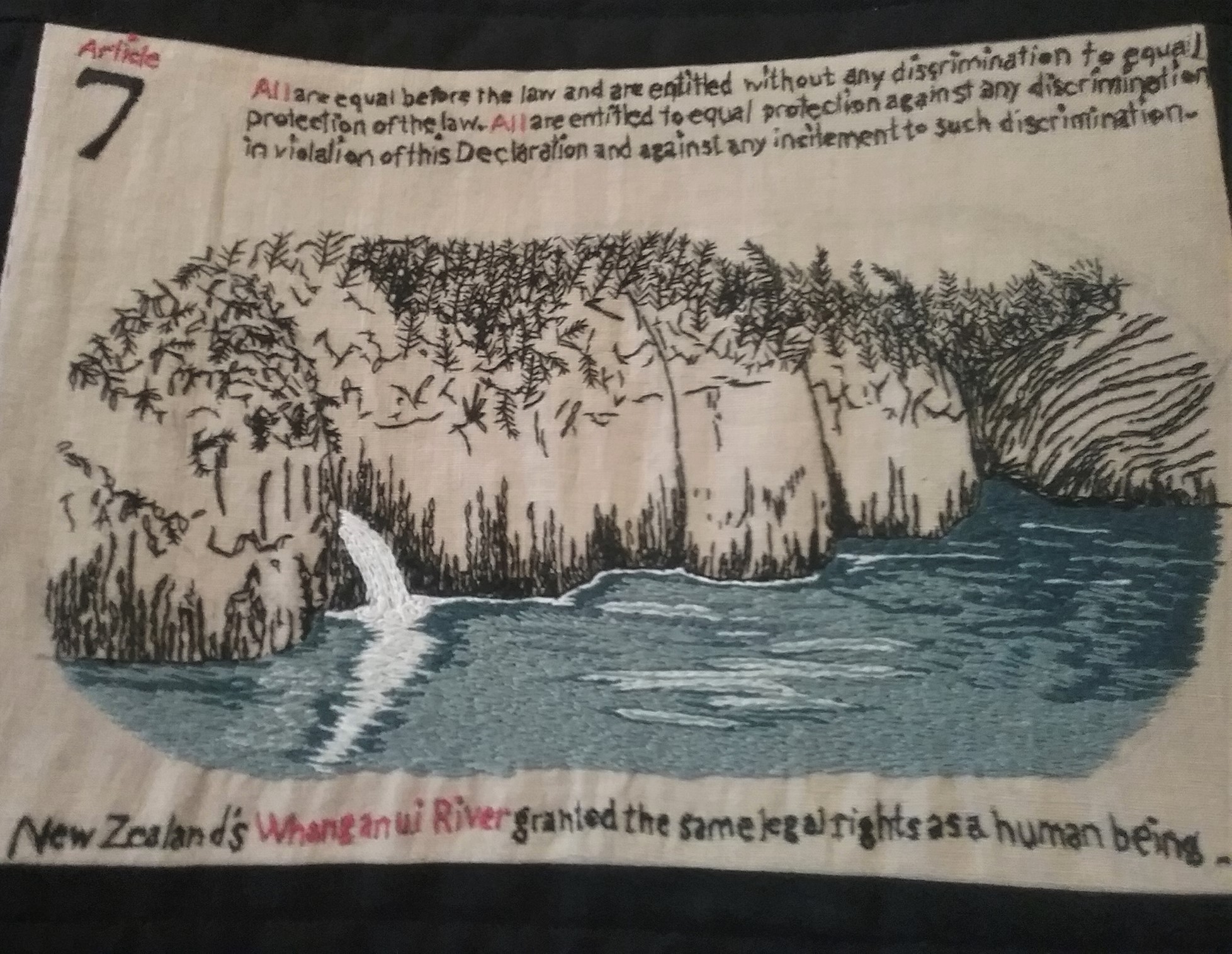
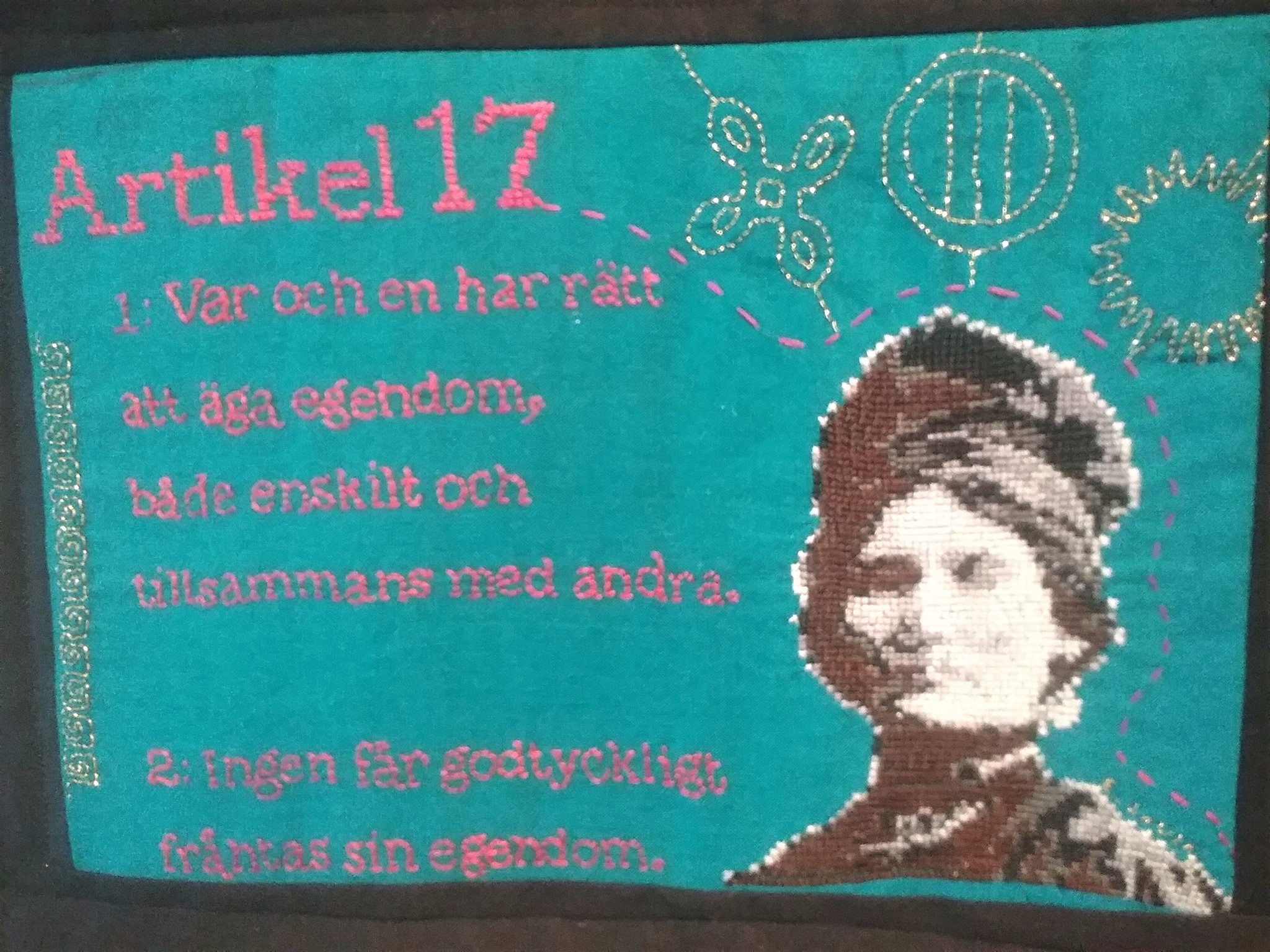
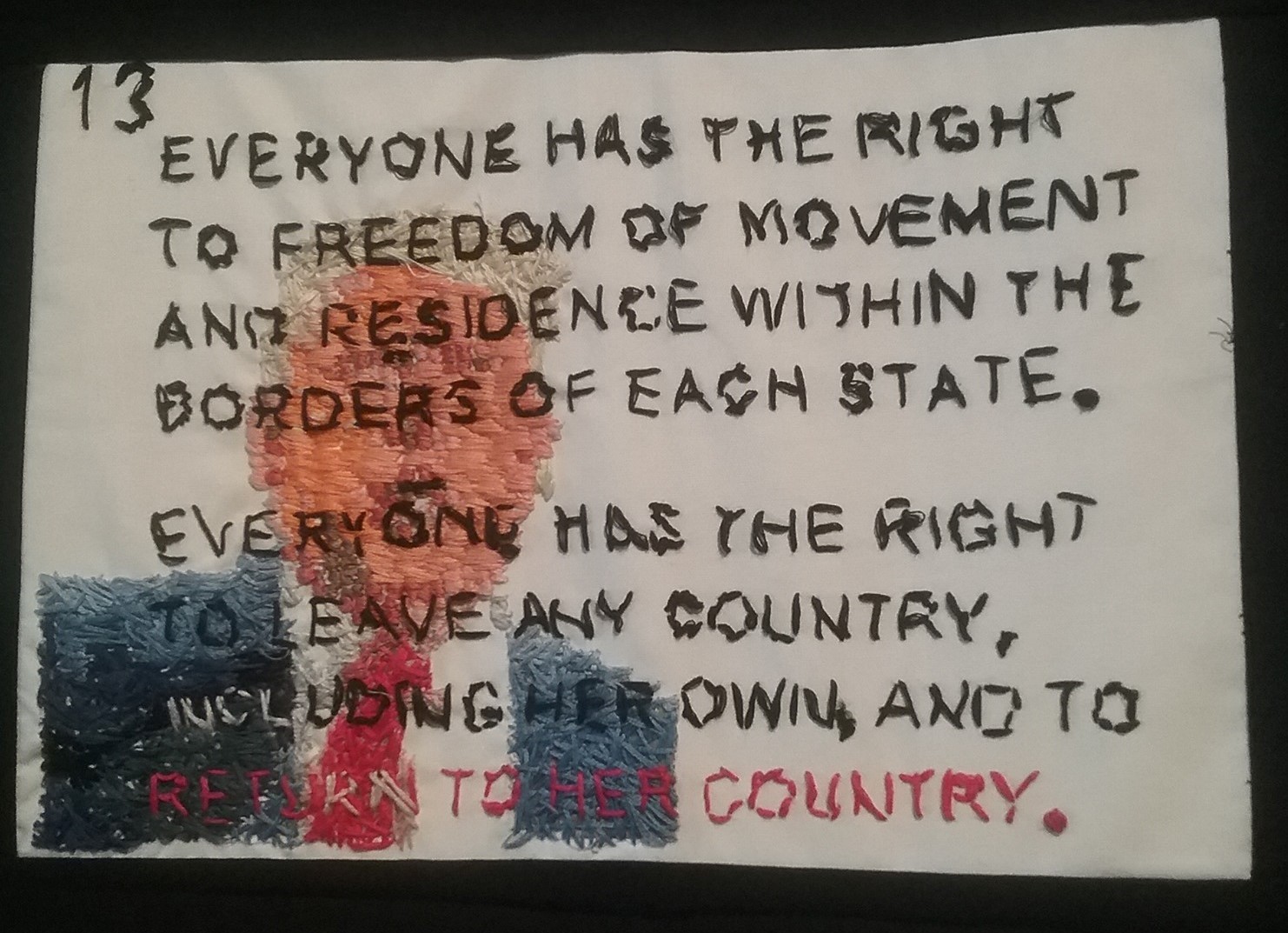
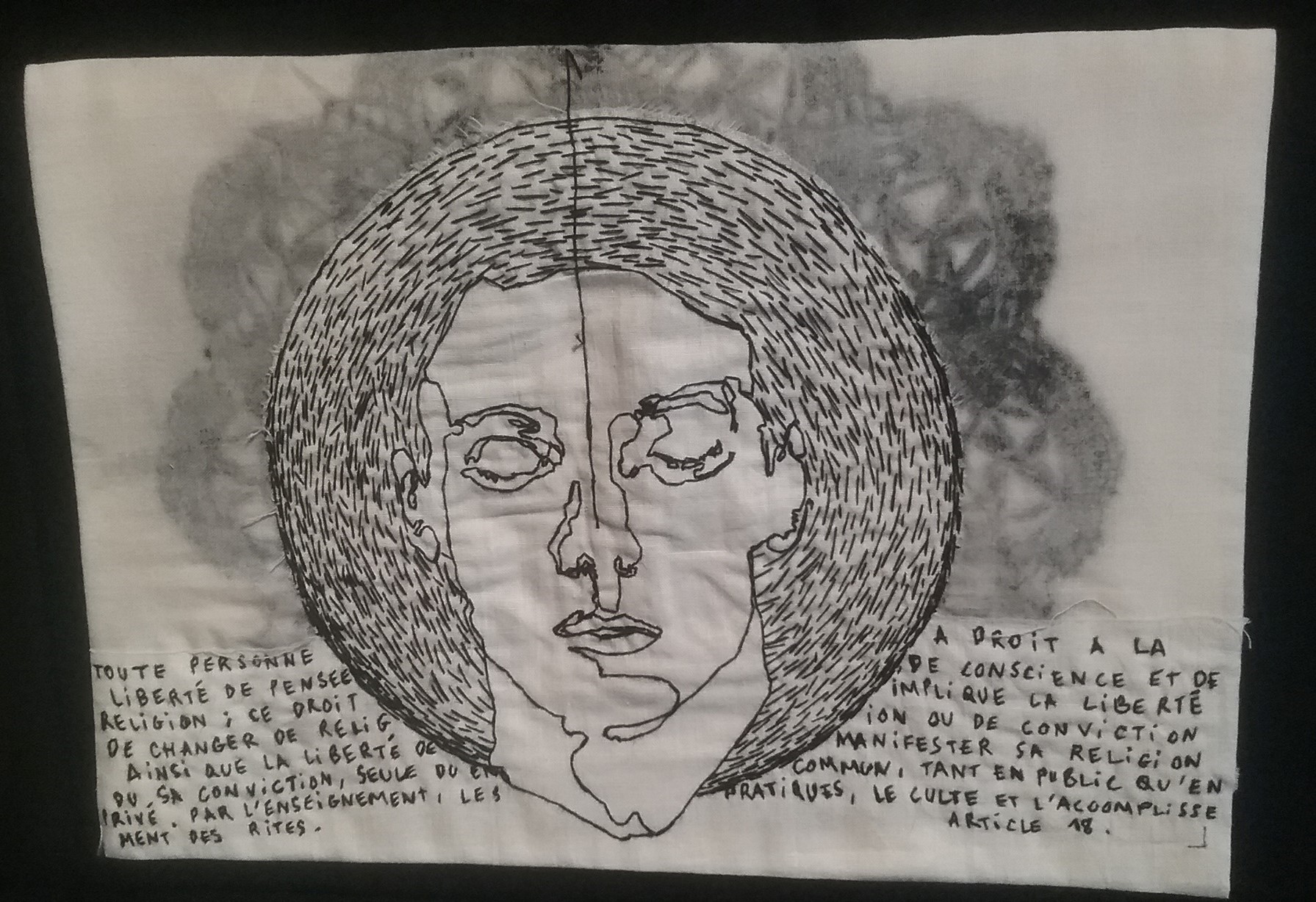
Textile Exhibition of the UN Declaration of Human Rights, Old Parliament House Canberra, December 2019.

I do not pretend to understand the complexity of geo-political relations in Afghanistan. What I do know is that Afghanistan has been at the centre of a geo-political chess board for decades, stemming back to the cold war. I know that my government is not doing enough, with its draconian stance on refugees and its willingness to leave people who helped the Australian Defence Force to their fates.

And what I know comes from a space of heart rather than logic. I have taught Afghani refugees, most of whom were from the persecuted Hazara minority. I have heard stories of lives that I couldn’t even begin to imagine. And in the comfort of my safe Australian home, I have read news reports and books written by women who fear for their future.

From the perspective of someone who has found solace in creativity, reports of the the suppression of creative life under the Taliban are chilling. Under the Taliban between 1996 and 2001, all music, art and film that did not adhere to strict religious dictates were banned. We are not just talking about so called ‘imperialist art’, the likes of which were banned during China’s cultural revolution. This was not just garden variety censorship. Historical sculptures were destroyed. Folk music and singing that existed for centuries were banned.

The Taliban is not the first regime that has attempted to suppress creative expression. Dancing was and probably still is prohibited in some Puritanical Christian sects. In Australia, we banned Indigenous music, dance and ritual in our 19th century and early 20th century missions. Historical documents show that dance and music were banned on some slave plantations in America.

There is something sinister about the banning of folk art. Most folk music is benign and ostensibly not a threat to the political structure. The trope is predictable and almost universal. There are the love stories, the hero stories, the soldier stories, the working in the field stories. This form of creativity is what unites communities, providing comfort, stability and a sense of identity. Perhaps this is why totalitarian regimes seek to destroy all creative expression, from the overtly polemic to the benign lullaby one sings with a traditional instrument.

When a person is deprived of creative thought and expression, they may become malleable and hollow. The best way to oppress a people is to kill their spirit, so they become fearful automatons. One of the things that separates human mammals from non human mammals is creative expression. In the totalitarian playbook, the creatives are always the first to be executed, along with the political dissidents. In advanced totalitarianism, all creativity is quashed.

But it is not possible to oppress people forever. Humans find a way. In Pinochet’s Chile, all correspondence out of the country was intercepted, so the international community would not hear of the horrors occurring. But I have heard that women began embroidering their stories on cloth, and sending their needlepoint to their relatives overseas. In their arrogance, the regime believed that embroidery was simply something women did to pass the time, and did not stop to look at the embroidered pieces.

Closer to home, Kurdish journalist Behrouz Boochani wrote his biography ‘No Friends But The Mountains,’ on a smuggled mobile phone while indefinitely detained for seeking asylum by the Australian government.

Creative dissent cannot be completely quashed, and these examples provides a sliver of solace in the darkness.

Graffiti art from the Melbourne CBD, March 2020

Artistic inspiration during lockdown?

“The cause of plagues is sin, and the cause of sin is plays.”

A preacher in Elizabeth England, possibly in response to Shakespeare’s plays.

Bloody brilliant, I say. The highest praise you can give a writer is to tell them that their writing caused the latest plague. Don’t tell the conspiracy theorists though…that is a whole other labyrinth of madness.

One of my friends texted me last week and asked me if she had properly signed up to this blog. She wasn’t getting any blog notifications, she said. I had to inform her that it was because I wasn’t writing content that was in a shareable state. And it is true that there is always a writer’s draft and then there is a reader’s draft.

But I haven’t been writing publicly because the content of my journals would read like a Live Journal circa 2003 and I really don’t want to drag others down into my personal mire of malaise. Despair is probably a more accurate word.

One of the myths around creative practice is that creative types ‘need’ depression to activate the creative juices. I call B.S. There is a relationship between the extremes of emotion and creativity, but I think the causation is reversed. Creative life helps us with despair, and not the other way around.

Another friend told me that her daughter, also a writer, is struggling with inspiration at the moment. Inspiration often comes from observing life around you, by sitting in a coffee shop and listening, for example. Inspiration comes from immersing yourself in the ebb and flow of life. At the moment, life is certainly not flowing for us in Australia.

Lockdown is a unique crisis in that we are forced to experience it in isolation. One of my Melbourne friends, when I asked her how she has coped with a prolonged lockdown, said “Look, I tell myself that all the government wants me to do is stay at home. I can do that. It’s not like they want me to fight a war in Europe or anything.” I also have friends who’ve lost generations of family members in South America. Compared to such loss, staying at home seems like a simple ask.

But as human mammals, primed for interaction, lockdown has severe implications for those of us living on our own. The chattering mind is a dangerous place to be lost in. And for a writer, stream of conscious writing died with the Modernists. So what is the answer when we are starved of inspiration?

Seek comfort rather than inspiration, is my answer. If it means reading fantasy or improbable crime fiction, than so be it. If it means taking photos of flowers on your android with an Instagram filter and calling it ‘high art’, then so be it.

And maybe there’s a case for accepting bleakness and writing through the bleak. Apparently, Shakespeare wrote King Lear during the bubonic plague, and if I’m honest, who doesn’t love a tragedy with a bit of eye gouging? 300 years prior Boccaccio wrote The Decameron during the black plague in Italy. In full disclosure, I am still on page 3 of the book, but I’ve been told that out of bleak can come the bawdy and the tragi-comic.

Because really, if you follow the bleakness through to its logical conclusion, we encounter a bit of lightness, a glimmer of hope and a large slathering of absurdity.

Covid kilos, cake and kindness

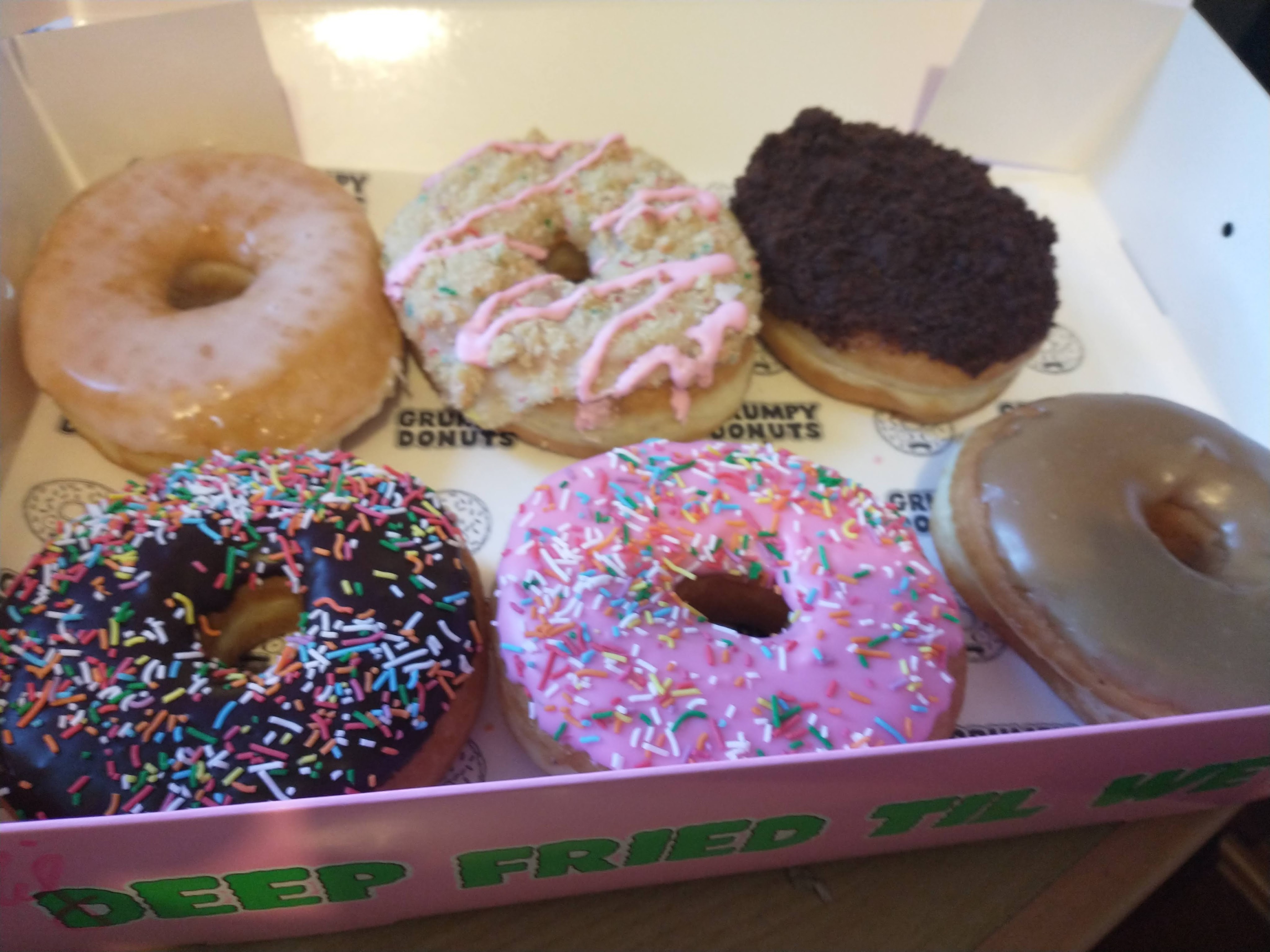
A shout out to Sarah, in Melbourne who ordered me Grumpy Donuts for my birthday

I love cake.

When I eat vegan Italian yoghurt cake, it feels like I’m making love to a cloud. Pink yeast donuts taste like happiness and there’s a plant-based chocolate mud cake from South-West Sydney that tastes like holiness. I haven’t met a cake that I didn’t like. Except for “cakes” made by misanthropic bakers who replace sugar with Splenda and vegetable oil/butter with coconut oil. Those “cakes” taste like sadness and don’t count as real cakes.

Apparently the covid kilos are inevitable. I know lots of people are bored or suffering plague malaise. They attribute their covid kilos to boredom. Personally, I’m not bored. I’ve found a myriad of things to do in lockdown. Learning an obnoxiously high-pitched instrument is a lot of fun. But I still court those covid kilos.

It does make me thing about the role of food in our lives in times of uncertainty, crisis, and loneliness. In almost every culture, food is not just nourishment. Food is used in celebration, as a reward and sometimes as a sign of love. In many Asian cultures, the first thing you say when you greet a friend or family member is ‘Have you eaten?’ I’m certain there are comparable phrases in other cultures.

Now our friend Freud might say my love of cake is symptomatic of an oral fixation, unmet needs in infancy etc etc etc, but that’s a rabbit hole for which I don’t have time.  Instead, I’d like to take my analysis out of the psycho-analytic gutter and examine food craving in the context of human needs. Maybe our desire for comfort food is symptomatic of a desire for deeper connection. We desire the sensation of connection with others and ourselves. We desire comfort. We desire kindness.

But we’re taught to be islands of self-sufficiency. The Western lone hero does not ask for comfort or kindness. We are taught that kindness interferes with achieving our goals of success and proving that we are better than others. We’re taught that the only connection that is worthy is the one that takes place in the bedroom with an intimate partner.

We’re taught not to reach out if we are struggling, lest people see our human frailty.

We’re taught a lot of B.S aren’t we?

When there’s no one around, and the voices in our head are rather unkind, a donut (or a box of donuts), a piece of cake (or the whole cake), a piece of apple pie (or the whole pie), helps us forget our human desperation and disconnection. For a few minutes we are nurtured, loved, and connected.

Here’s the thing about cake. We can trust cake. Cake will not disappear or run off with another human on its own volition. Cake does not judge, or mock or make unkind statements. It just is.

We can be entirely vulnerable around cake.

I don’t know what the solution is. Perhaps it is about nurturing kindness towards our selves. Perhaps it is about nurturing self-friendship. Or maybe it is about daring to be vulnerable with others. Maybe it is about picking up the phone and saying, “Hey I’m learning an obnoxious instrument, I’m writing word upon word, but still, I feel sad.”

So of course, we should still eat the cake. But let that be the start of our kindness to ourselves, and not the end. Perhaps we can pick up the phone with one hand and hold the cakey fork with the other.

The Ferryman 3: the apprentice

In Greek and Roman mythology, while the Ferryman was charged with transporting the dead to the underworld, occasionally he would transport the living to the underworld and back.

Look at that son. How’d ya be? 10 k lockdown radius and no one can get in or out! It’s like the heroin drought of 2002. There’s no green going around to buy or sell, and the meth comes from the mountains and the south coast. Ha! hard times for a dealer I tell you.

What? Nah, don’t you worry. There’s always customers for me. Get this for a laugh son. Remember last year when the country was on fire? Yeah, well, in those towns surrounded by flames, I had my hands full with people queuing up, not for water and bread and dunny paper but for the bottle-O. Lines down the street, I tell ya, people walkin’ away with trolleys filled with slabs of beer. People’ll always find a way…but…

But, listen. I gotta be straight with you.

It ain’t easy. I know your mum told you to get a trade, have a Plan B if the muso thing don’t work out for ya, but are you sure want to train with me? Yeah, nah, the government gives me a subsidy to take you on, but I want to do right by my nephew.

Yeah, the job has its perks but it’s a hard slog all the same.

What? Ok, yeah. Fair enough. Let me show you the ropes and then you can decide. Yeah, jump on the boat, no time like the present. So, see this river here? This river has different names. Some call it the River Acheron, others call it the River Styx. Don’t care what you call it, this river here is my patch. You just need to remember what it does son.

It divides the living from the dead.

Now that other river…that’s not really my patch. Sometimes a punter will pay a bit more and I’ll share it with that bird Lethe, and she’ll let me go up that river of forgetfulness….

Oi, are you listening to me? Put that bloody phone away and learn something! I don’t care if you’re taking a selfie with that centaur…what? You want to record this on your vlog?  Are you sure people want to watch this?

Really?

Streuth! Back in my day, you’d give up half a day’s work to watch a play by Sophocles in the ampi-theatre but that was real art. Yeah, ok. You can keep your phone on you. But just you pay attention, some day you’ll be out on the boat yourself.

Ok, now what was I saying? Yeah, this river here. It divides the living from the dead. Now, when I first started in the business, I used to get a different kind of customer. Problem with that sort of customer was they were already bloody dead! You got your coin but that was it! See the problem with that? Well…do you? You get a customer once! Once! They never come back.

Now, sometimes you’d get the odd customer who wasn’t dead. Hero wannabes…don’t get me started on that poser Sisyphus. Yeah, them lot,  they’d be on some sort of crusade, usually to impress a lass, or rescue a lass who’d gotten lost in the underworld. There was this one lass, Persephone…she was a real looker. Anyway, I sat there thinking and I says to myself, Charon mate. Think long term.

The dead only pay once, and A league gods come and go. Do we even have those types of gods these days?

…What?

Really?

What in Hades is a ‘social media influencer;?

In my day a god didn’t need a social media presence.

Anyways, I says to myself, diversify. There’s nothing in the oracles that says I can’t change the rules up. It’s a riddle. What’s the difference between the dead, a god on an ego quest and an addict?

Nah, think it through boy!

They’re all seekers, don’t ya see? They’re all desperate to leave this world, even for a short while. You and me, we provide them a service. Don’t let people judge you, boy. People act like this earth is the place to be, but the stories I hear on the boat, I tell you. I’ve heard it all.

If you don’t learn anything else today, son, just remember this.

In this job, we don’t judge. This earth is meant to be paradise, but most people spend their lives doing anything for a bit of a peace and a bit of love. The inferno’s on earth boy, not anywhere else.

That’s why I have a soft spot for the living seekers.

They’re the only ones who see this world for what it really is. And if you see the world for what it really is, it’ll break your bloody heart.

Links to previous parts of this short story

The Ferryman 2

In Ancient Greece, the Ferryman was named ‘Charon’, meaning ‘he of the keen gaze.’ Writers of antiquity represented the Ferryman in multiple ways, ranging from a sordid god, to a surly old man, to a silent, hooded figure.

Lungs like Teflon that one. She’s a lifelong punter.

Nah, you started it mate, so if you can’t hack it, you shouldn’t dish it out. You’re with me for the day. I’ll show you a day in my life. Think of it as bloody celebrity apprentice.  I know I said the methadone clinic is trying to royally shaft me, but you gotta keep thinking, there’s customers there who use on the side. See that one, that guy over there, been on the ‘done for 20 years, but don’t think he doesn’t slam a bit of ‘done in his veins on the side and smoke the odd pipe.

He’ll see me right into retirement, that one.

No, you dickhead! Don’t let ‘em see us. Get behind the car. Not that they see me, mind you. I’m just here.

What? Yeah. ‘Course they drug test ‘em. But nah they don’t kick ‘em out of the program, they’re raking it in! That owner’s making the big bucks. He’s a bloody wanker, that one.

Shhh, watch. See that one going into the clinic? Yeah, the girl. Look at her. Nah, really look at her. What do you see?

Nah. You’re not looking hard enough. That’s the problem with you and the likes of everyone else. I said to her on the boat once, they don’t see you. Not really. They name you as a thing and then they see you as that thing. Don’t ever let ‘em name you and yeah, she took an old man’s advice. Can’t say I’m not proud of the lass. She’s on the lowest dose of bupe, 2mg. Methadone’s kid sister, mate!

But listen yeah, that girl, she keeps herself to herself. Gets her dose, leaves, doesn’t make small talk. She’s been to uni, got a job, she’ll see me into retirement too.

What d’ya mean how?

Nah, listen. See how thin she is? She’s stopped eating.

Nah, she’s not on the ice, but it’s the hunger that stops her from feeling now, not the gear. And listen, I’m no mug, but I’ll take all kinds of currency. Up to a point though. You should see the young lads playing video games 24-7. Tried to pay me in bitcoin or whatever nonsense that is, but I said…listen, you little shits, I been doing this job for centuries, and ain’t ever heard of this bitcoin.

Paper money comes and goes. Ever been in a country where it takes a wheelbarrow of cash just to buy some bread? Inflation mate.

You gotta have financial nouse to be around as long as I have. Nah, I says to ‘em, I’m a fair bloke. I said to ’em, don’t kid a kidder. I only accept organs and bones, your sanity, memory, worth, relationships, motivation, passion…that sort of thing. That’s true currency.

But back to that girl. Yeah, I’ve got her for life.  She’ll cruise from one addiction to another, legal or not. Bloody oath she will. And she’s got enough life in her to keep going on, but she needs a buffer to get through this whole clusterfuck of existence.

That girl, I need more punters like her. Steady enough to pay, but she’s too scared to live, too scared of getting close to anyone. Them ones, they always make the best bloody customers.